
Design for Disconnection
Over the course of 2025, we spoke with activists living and working in both connected and remote parts of Africa. We wanted to understand their experience of work when they are without an internet connection. Further, on behalf of Briar, we aimed to identify a place for short range peer-to-peer technical functions to live in regular tasks.
Our research spanned a broad exploration of critical needs for connection—to understand what’s important to support by any technology—and a narrow exploration of the applications for peer-to-peer (P2P) solutions. This paper provides a perspective into what's needed most and discusses technology futures through the lens of activists' needs and realities.
It reframes what it means to be connected and urges tech sector to do the same as we build resilient products.
It underscores the need for two categories of innovation: alternative networks and product integrations; and provides design heuristics for technologies in each category. Namely: knowledge hubs, messaging networks and offline sync features.
It highlights the social factors involved in deploying unfamiliar technologies and considers the benefit of partnering with those "in the middle," individuals regularly moving between the connected and disconnected states, on the design and deployment of shutdown resistant tooling.
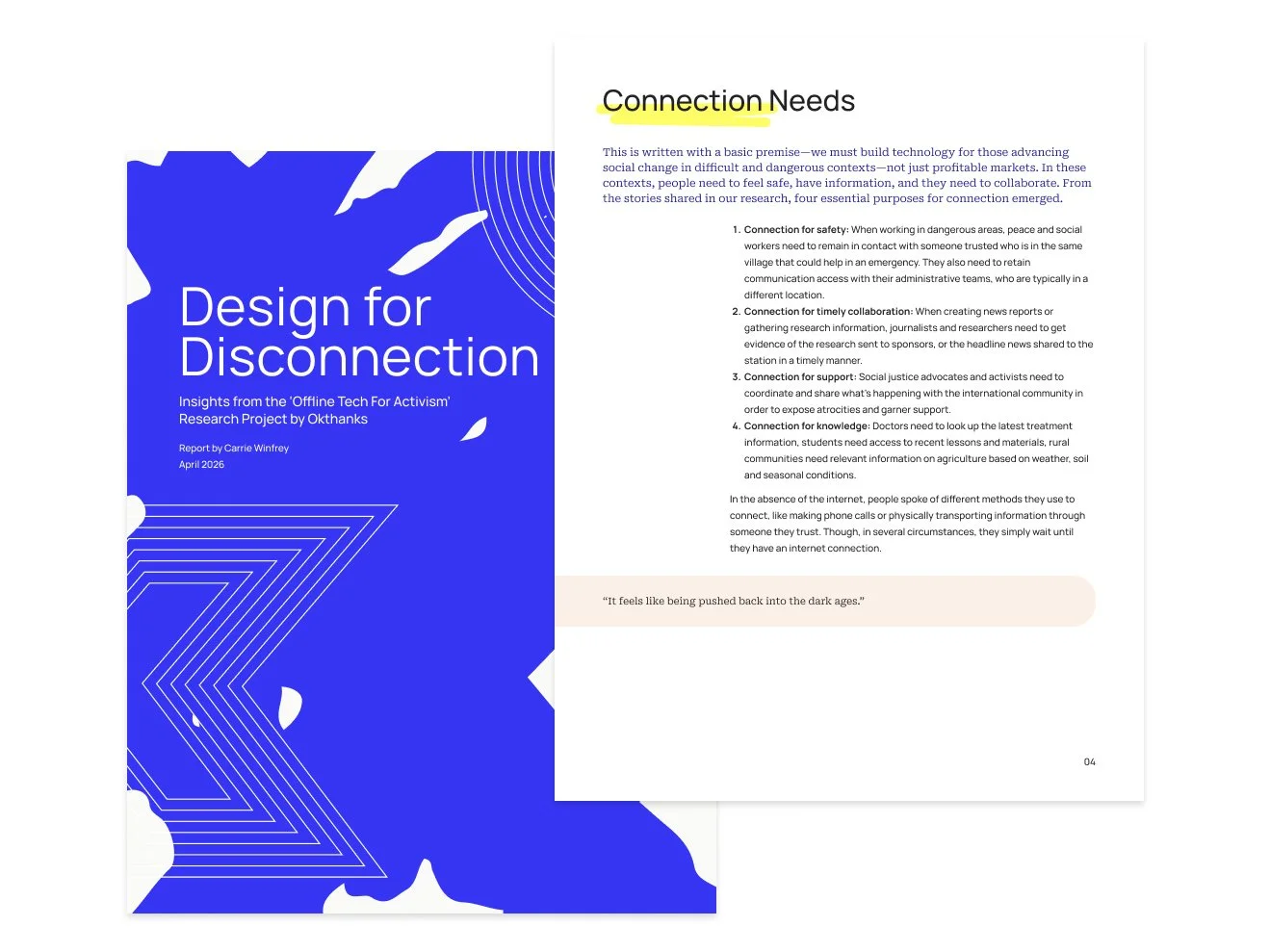
Design for Disconnection: Insights from the ‘Offline Tech For Activism’ Research Project by Okthanks. (30-45 min read)